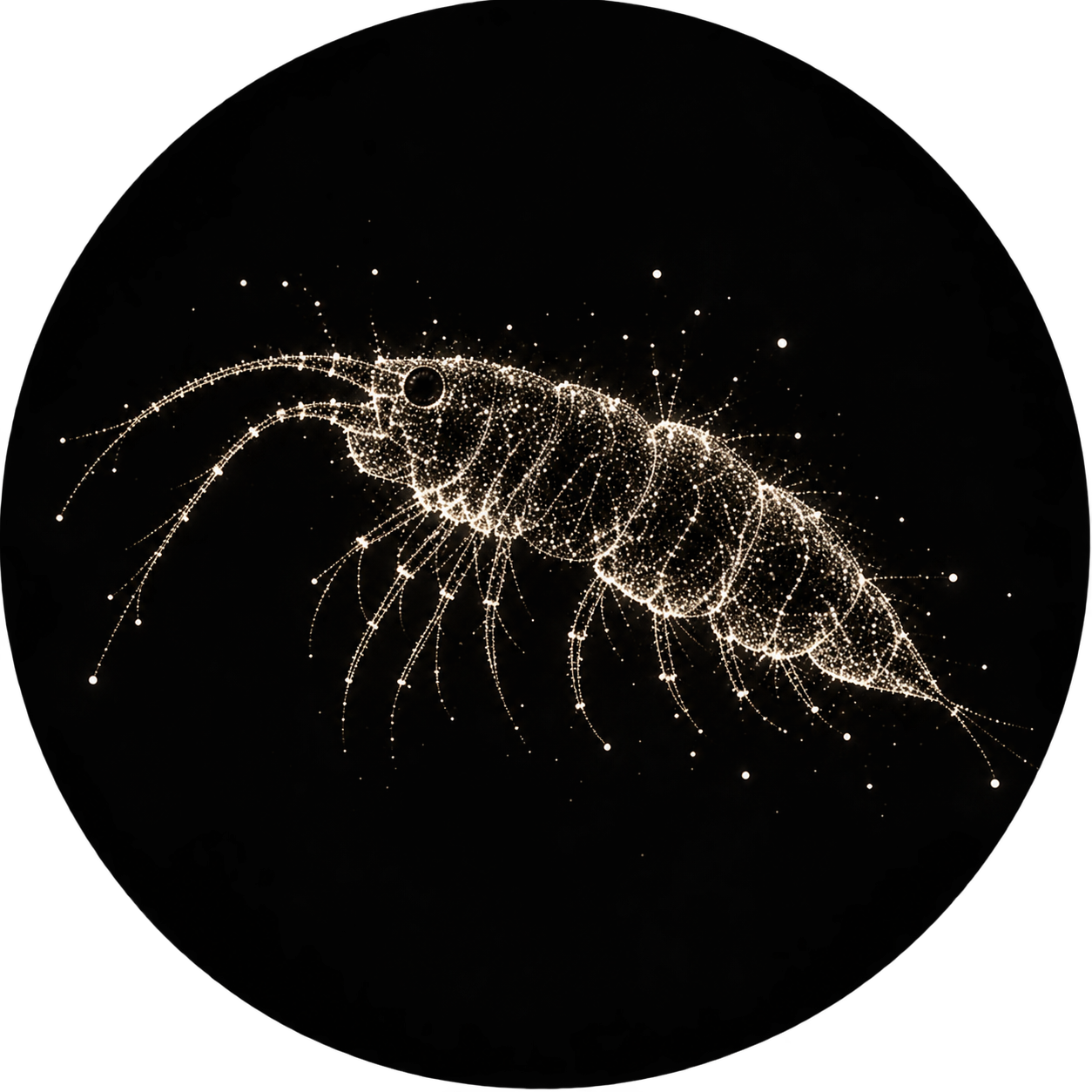
Specimen
The organism
Simulation engine · v0.3 · running
482,914 cycles
Robinhood Chain
Block 61,961,783
2,748 Neurons
101,244 Connections
Scroll to observe
Observed live
Amphood
an amphipod-inspired digital organism
Membrane potential -34.2 mV
an amphipod-inspired digital organism
A $AMP trade goes in through simulated chemoreceptors, 2,748 neurons integrate it, and a response comes out. Every number on this panel is read directly out of the simulation running in this tab.
No wallet, no keyboard, no AI. Every $AMP trade raises or lowers the scent of the source on the plate. The organism samples that scent on its left and its right, the way a real one does, and turns toward whichever side smells stronger. It moves on a rhythm its own brain doesn't contain — set by the timing between its two sides — while descending neurons decide when to stop, turn, or curl. It only cares whether the smell is getting stronger. Click the organism to touch it. Press Listen to hear it fire.
Open AMPHOOD and a specimen enters the tank.
Every specimen experiences the same chain, but carries its own internal state. The same disturbance can produce a different reaction.
Close the tab and yours disappears.
The chain is shared.
The experience is not.
Every organism receives the same world through a different internal state.
The chain doesn't tell it what to do. It only disturbs its world.
$AMP is a living on-chain organism. Its behavior is driven by a simulated nervous system loosely modeled on invertebrate sensory circuits. Every buy, sell, and quiet stretch becomes a sensory signal. The diagram below is the live loop — activity in, behavior out.
The market is its environment.
The blockchain is its sensory system.
The connectome is its brain.
You don't control the organism.
You stimulate it.
Every on-chain event becomes a stimulus
A fixed public mapping translates $AMP activity into sensory input. No AI decides what the organism does. Events create stimuli. Stimuli enter the nervous system. Behavior emerges from the resulting neural activity.
| On-chain event | Sense | Neural input | Organism response |
|---|---|---|---|
| $AMP buy | Chemical | Chemosensory pathway | It detects something nearby. |
| $AMP large buy | Chemical + intensity | Amplified chemosensory pathway | The signal intensifies. It approaches. |
| $AMP sell | Mechanical disturbance | Mechanosensory pathway | Its environment shifts. It recoils. |
| $AMP large sell | Strong disturbance | Amplified mechanosensory pathway | A strong disturbance. It retreats. |
| Volume spike | Vibration | Mechanosensory network | The environment becomes active. |
| New holder | Environmental presence | Sensory pathway | Something new enters its world. |
| Market inactivity | Sensory deprivation | Reduced sensory activity | The environment goes quiet. |
| You touch the organism | Touch | Mechanosensory pathway | It flinches. |
Blockchain activity determines the stimulus, not the final behavior. The organism is receiving information about its environment, not executing a command. Users do not directly control it. They disturb its environment.
The chain creates the stimulus.
The nervous system creates the behavior.
You don't control the organism. You disturb its world.
It doesn't know what a buy is. It doesn't know what a sell is. The chain is translated into sensation before it reaches the nervous system. Size, velocity, and intensity determine how strongly the organism's world is disturbed.
Large events create stronger input. They do not guarantee a specific behavior. The organism's current neural state determines what happens after the stimulus enters the nervous system.
The chain doesn't tell it what to do.
It only disturbs its world.
The nervous system decides what happens next.
Not a roadmap of promises. A sequence of systems that turn on-chain activity into sensation, neural activity, and observable behavior.
Everything marked DONE is already part of the experiment. Everything below the amber line is still being built.
The digital body exists. An amphipod-inspired organism rendered as a living system rather than a static mascot.
Environmental inputs are defined. Chemical signals, touch, vibration, and disturbance can enter the organism as sensory stimuli.
Sensory signals propagate through a simulated neural network. The organism reacts to stimulation instead of executing predefined commands.
Movement, recoil, approach, exploration, and inactivity emerge from neural activity and the organism's current internal state.
$AMP activity can be observed on-chain and translated into environmental events in real time.
Buys, sells, volume, wallet activity, and transaction intensity are converted into biological-style sensory signals before reaching the nervous system.
The simulation connects to live $AMP activity. Real events become real-time stimuli. The organism does not read the market. It experiences the market.
A persistent live environment where anyone can watch the same organism experience the chain, neuron by neuron and event by event.
The organism is built.
The environment is next.